
Sourced from AAP, Cleveland Clinic, CDC and NIMH guidance. Last checked .
On this page
- What does a newborn night shift schedule have to work around?
- Where does the baby sleep during a night shift?
- Which schedule fits your family?
- How do you do shifts with a newborn when you’re breastfeeding?
- What if you pump or give bottles of expressed milk?
- What does a formula-fed night shift look like?
- How do you add a grandparent or nanny to the rotation?
- What goes in a shift handoff?
- What if the schedule isn’t working?
- When should you worry?
- How are you doing?
- Print the plan
- Quick answers
- How many hours apart should a newborn feed at night?
- Can a newborn go 4 hours at night?
- What is the 3-3-3 rule?
- Keep the night in one place
The simplest newborn night shift schedule splits the night into two blocks, about 9 PM to 2 AM and 2 AM to 7 AM. One adult is on duty, awake and in charge of the baby, while the other sleeps. Below are four versions with clock times, for nursing, pumping and bottle-feeding families and for a helper.
The times are samples, not rules. Your baby sets the clock, so slide every time to match your night.
What does a newborn night shift schedule have to work around?
Three things, and a good plan bakes all of them in.
Feeds. The AAP says breastfed newborns usually feed 8 to 12 times in 24 hours, and a baby shouldn’t go longer than about 4 hours at night without a feed in the early weeks. Even if you have to wake your baby, the AAP’s advice is to get those feeds in. Formula-fed newborns often eat every 2 to 3 hours, then every 3 to 4. If one sleeps longer than 4 to 5 hours in the first few weeks and starts missing feeds, the AAP’s advice is to wake them and offer a bottle. Ask your pediatrician when it’s OK to stop waking your baby.
That means nobody sleeps through the whole night, and a nursing parent’s “protected block” still has a feed in it. Every schedule below plans for that.
Sleep. Cleveland Clinic puts newborn sleep at 14 to 17 hours in 24, spread across the day and night. The baby’s sleep and yours won’t line up, which is the point of shifts. Aim for one longer stretch each, not a perfect night.
Safe sleep. A shift plan has to answer a question most schedules skip, which is the sleep space while one of you is off duty.
Where does the baby sleep during a night shift?
On a firm, flat surface, on their back, every time. The AAP recommends sharing a room with your baby, but never a bed, for at least the first 6 months. A crib, bassinet or play yard that meets federal safety standards is the safe sleep space, with a fitted sheet and nothing else in it.
The AAP page doesn’t talk about split shifts, so here is what we can and can’t say. The AAP’s wording is about the room where you sleep. A plan that follows it to the letter keeps the bassinet in the bedroom, with the on-duty adult awake there and the off-duty adult wearing earplugs or sleeping nearby. The other common setup is for the on-duty adult to stay awake with the bassinet in another room while the off-duty adult sleeps elsewhere. That second setup is not the exact room-sharing advice, so ask your pediatrician which one they prefer.
Two rules apply to whoever is on duty, including grandparents and nannies:
- Stay awake. The AAP says the risk of a sleep-related death is up to 67 times higher when a baby sleeps with someone on a couch, soft armchair or cushion. Feeling drowsy? Put the baby in the bassinet, on their back.
- Back to their own space. If you nurse in bed, clear pillows and blankets away from the baby and put them back in their own space before you sleep. The AAP says bed sharing with someone who is fatigued carries more than 10 times the risk.
Nursing pillows and loungers aren’t made for sleep. If the baby dozes off in a swing or car seat, move them to their own crib or bassinet, on their back.
Which schedule fits your family?
| Your setup | Try this | The catch |
|---|---|---|
| Nursing, partner helps | Breastfed schedule | One feed breaks the nursing parent’s block |
| Nursing plus pumped bottles | Pumped schedule | Pumping still has to happen |
| Formula | Formula schedule | Prep bottles safely at night |
| Grandparent, nanny or friend helps | Helper rotation | Helper needs the safe sleep rules |
How do you do shifts with a newborn when you’re breastfeeding?
Give the partner everything except the feed itself. Parent A is the nursing parent and Parent B is the partner.
| Time | Parent A (nursing) | Parent B (partner) |
|---|---|---|
| 8:30 PM | Nurses, then goes to bed | Burps, changes, settles baby |
| 9 PM-2 AM | Off duty, asleep | On duty, awake |
| About 11:30 PM | Nurses | Wakes A, brings baby, takes baby back after |
| 2 AM-7 AM | On duty | Off duty, asleep |
| About 2 AM and 5 AM | Nurses | Asleep |
Why 11:30: after an 8:30 PM feed, a feed by 12:30 AM keeps the gap within the 4 hours the AAP gives for the early weeks. If the baby shows hunger sooner, wake A sooner. The on-duty partner stays awake the whole feed, so nobody drifts off holding a baby.
The trade-off is plain. B gets one 5-hour stretch, and A’s sleep is split by one feed. One way to even it out is to let the nursing parent sleep in once the day starts. For the full partner task list, a post on splitting night feeds when breastfeeding is coming next.
What if you pump or give bottles of expressed milk?
A bottle lets the partner do the whole feed.
| Time | Parent A (pumping) | Parent B (partner) |
|---|---|---|
| 8:30 PM | Nurses, then goes to bed | Burps, changes, settles baby |
| 9 PM-2 AM | Off duty, asleep | On duty, awake |
| About 11:30 PM | Pumps about when baby feeds, then back to bed | Gives a bottle of expressed milk, burps, settles |
| 2 AM-7 AM | On duty | Off duty, asleep |
| About 2 AM and 5 AM | Nurses | Asleep |
The CDC says that when you’re away from your baby, try to pump as often as your baby is drinking breast milk, to help your body keep making the amount of milk your baby needs. So a bottle that A doesn’t nurse is a pump session A still needs. That’s why A is up briefly at 11:30.
One option is to give the nursing parent one long stretch on a trading night by skipping the overnight pump. That is a trade-off for supply, so ask your pediatrician or a lactation consultant before you rely on it. If you’re breastfeeding, ask them when to start bottles.
What worked in our family. At home, the parents behind JoyNap fed our baby breast milk from a bottle. Mom pumped, and Dad gave the night bottles while she slept. Her supply was good, so she could pump less often than the baby fed, which gave her longer stretches of sleep, and it lasted us long term. That won’t be true for everyone, which is why the CDC’s advice above is the starting point. Our take: nursing every feed is hardest on the nursing parent when a baby goes through stretches of feeding very often, and a pumped bottle is one way to share that load.
Milk storage at night. The CDC says freshly pumped milk keeps up to 4 hours at room temperature (77°F or colder) and up to 4 days in the refrigerator. Label each bottle with the date it was pumped. The CDC says leftover milk is OK for up to 2 hours, and the AAP says to discard what’s left in the bottle after 1 hour. When two sources differ, go with the shorter time.
What does a formula-fed night shift look like?
With formula, either adult can do any feed, so you can split the night evenly.
| Time | Parent A | Parent B |
|---|---|---|
| 8:30 PM | Last bottle, burp, settle | Sets up the bottle station |
| 9 PM-2 AM | Off duty, asleep | On duty, feeds at about 11:30 PM |
| 2 AM-7 AM | On duty, feeds at about 2:30 AM and 5:30 AM | Off duty, asleep |
B covers one feed and A covers two, so swap the shifts every night and the load evens out. Early on, expect feeds every 2 to 3 hours, the AAP says.
Bottle prep at 3 AM. The CDC says to use prepared formula within 2 hours of preparing it and within 1 hour from when the feeding begins. If the feed won’t start within 2 hours, put the bottle in the fridge right away and use it within 24 hours. Throw away whatever is left after the feed, because saliva in the bottle lets bacteria grow. For a baby under 2 months, born before 37 weeks or with a weak immune system, the CDC says to mix powder with water that was boiled and left about 5 minutes (about 158°F), then let the bottle cool and test a few drops on your wrist. Never use a microwave.
How do you add a grandparent or nanny to the rotation?
Give the helper one shift and keep the rest of the pattern steady. This week-long grid has the helper on 4 nights, and each parent gets 2 nights with one long block of sleep.
| Night | 9 PM-2 AM | 2 AM-7 AM |
|---|---|---|
| Mon | Helper | Parent A (B sleeps all night) |
| Tue | Parent B | Helper (A sleeps all night) |
| Wed | Parent A | Parent B |
| Thu | Helper | Parent B (A sleeps all night) |
| Fri | Parent A | Helper (B sleeps all night) |
| Sat | Parent B | Parent A |
| Sun | Parent A | Parent B |
If you’re nursing, “sleeps all night” still means being woken for feeds, about every 4 hours at most in the early weeks, per the AAP. On those nights the helper brings the baby to you, or gives expressed milk. The grid also works for a night nanny on more nights.
Before a helper’s first shift, hand them these in writing. The printable has them on one sheet.
- Baby always goes down on their back in the bassinet.
- Nothing soft in the sleep space. No pillows, blankets or bumpers.
- Stay awake. Never fall asleep with the baby on a sofa or armchair.
- Where the bottles, diapers and wipes are, and when the next feed is due.
- The pediatrician’s number, and the warning signs below.
A grandparent who raised babies decades ago may know the old advice. The AAP’s current page is a good thing to read together before the first night.
What goes in a shift handoff?
A handoff takes two minutes and saves a 3 AM guess about who fed last. Say or write:
- Time and kind of the last feed (side or ounces).
- Last diaper.
- When baby last fell asleep and woke up.
- Anything that felt different, and any temperature taken.
- Bottles ready, and what needs pumping.
- Who’s on next, and the time.
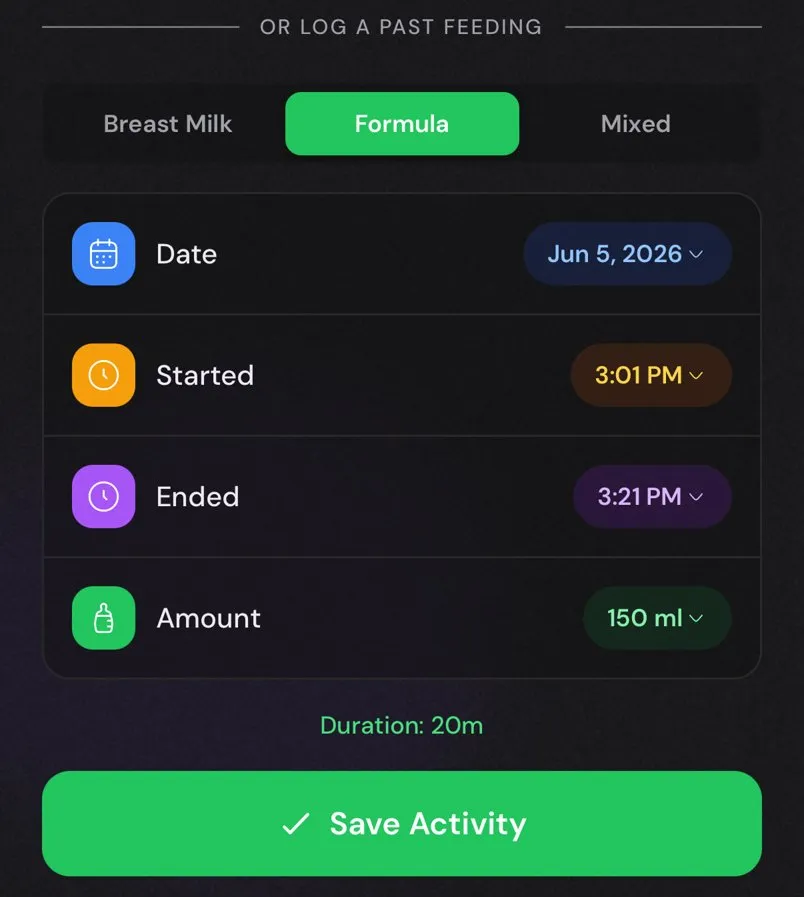
JoyNap can hold the first three for you. You log feeds (breastfeeding timer for both sides, bottles and pumping), diapers and sleep, and the Timeline shows every logged activity in order, so the next person sees when the last feed and diaper were. Every caregiver sees the same day live on their own phone, and dark mode keeps it easy on tired eyes at night. Say the other three out loud at the handoff. A paper sheet works too.
What if the schedule isn’t working?
Change one thing for a few nights and see. Trade the order of shifts. Move the handoff time by an hour. Try alternating whole nights instead of halves. Losing your temper? Lay the baby in the crib on their back, and step out for about 10 to 15 minutes. Never shake a baby (AAP).
If one of you ends up doing all the nights, say so out loud, in daylight, not at 3 AM.
When should you worry?
Sleep loss is part of the first weeks, but these aren’t.
Call 911 if your baby is not breathing, or stops breathing for longer than 10 seconds, or their skin or lips turn blue, gray, purple or white, or they are limp, not moving or very weak, or you can’t wake them. The AAP’s list includes “can’t wake the baby up” and “not moving or very weak”. Hard to wake: go to the ER now. Pauses of 5 to 10 seconds can be normal in newborns, according to Cleveland Clinic.
Call your pediatrician right away if your baby is 3 months or younger and has a rectal temperature of 100.4°F (38°C) or higher, even if they seem fine. Don’t give fever medicine before your baby is seen (AAP).
How are you doing?
The NIMH says signs of perinatal depression can include difficulty sleeping even when the baby is asleep, and that most episodes begin within 4 to 8 weeks after birth. If that sounds like you or your partner, or you feel hopeless, or have trouble bonding with the baby, talk to a health care provider.
- Confidential support, 24/7, call or text: National Maternal Mental Health Hotline, 1-833-TLC-MAMA (1-833-852-6262).
- If you’re thinking about hurting yourself or your baby: call or text 988. In a life-threatening situation, call 911.
- Postpartum Support International’s HelpLine, 1-800-944-4773, offers support, but it is not a crisis line.
Print the plan
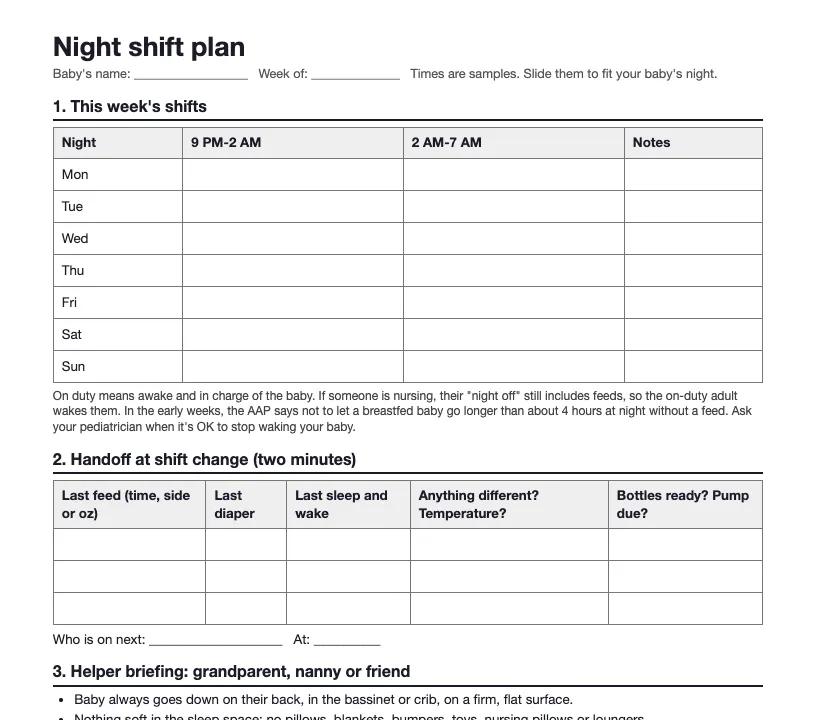
The printable has the shift grid, the handoff log, the helper briefing and the warning lines on two pages for the fridge. It’s a free printable, with no email needed.
Quick answers
How many hours apart should a newborn feed at night?
For breastfed newborns, the AAP gives every 1½ to 3 hours in month one, which is 8 to 12 times a day. With formula, feeds begin around every 2 to 3 hours and spread out to 3 to 4 by about a month.
Can a newborn go 4 hours at night?
About 4 hours is the outer limit in the early weeks. The AAP says to wake a breastfed baby who sleeps past 4 hours at night with no feed, and, for formula, to wake a baby who goes 4 to 5 hours early on and is missing feeds. Your pediatrician can tell you when waking is no longer needed.
What is the 3-3-3 rule?
It most often means the colic “rule of threes”, which is how pediatricians describe colic: crying for more than 3 hours a day, at least 3 days a week, for more than 3 weeks in an otherwise healthy baby (Cleveland Clinic). It describes a pattern of crying, not a feeding or sleep schedule. Call your pediatrician if the crying sounds different or comes with fever, forceful vomiting or a baby who stops gaining weight, and if you’re overwhelmed, put the baby down safely and step away.
Keep the night in one place
JoyNap is an iPhone baby tracker for shared care. You, your partner, grandparents and your nanny log from their own phones and see the same day live. Learn more at joynap.app.
Printable
Download the PDF to print, or make your own copy to edit. No sign-up needed.
Sources
- How to Keep Your Sleeping Baby Safe: AAP Policy Explained (HealthyChildren.org, AAP) healthychildren.org
- How Often to Breastfeed (HealthyChildren.org, AAP) healthychildren.org
- Breast-Feeding Questions (HealthyChildren.org symptom checker, AAP) healthychildren.org
- Amount and Schedule of Baby Formula Feedings (HealthyChildren.org, AAP) healthychildren.org
- How Often and How Much Should Your Baby Eat? (HealthyChildren.org, AAP) healthychildren.org
- Fever and Your Baby (HealthyChildren.org, AAP) healthychildren.org
- Sleep Basics (Cleveland Clinic) my.clevelandclinic.org
- Pumping Breast Milk (CDC) cdc.gov
- Breast Milk Preparation and Storage (CDC) cdc.gov
- Infant Formula Preparation and Storage (CDC) cdc.gov
- Abusive Head Trauma and Shaken Baby Syndrome (HealthyChildren.org, AAP) healthychildren.org
- Colic Symptoms, Causes & Solutions (Cleveland Clinic) my.clevelandclinic.org
- Periodic Breathing in Newborns (Cleveland Clinic) my.clevelandclinic.org
- Perinatal Depression (NIMH) nimh.nih.gov
Sources last checked .